
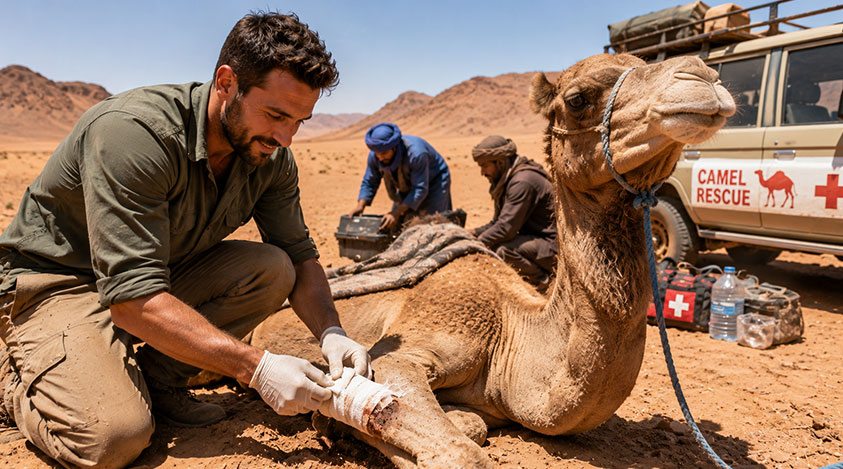
Before travelling into the Sahara, I had always thought of camels as perfectly adapted desert animals that could survive almost anything. They are strong, patient and capable of travelling long distances through conditions that would exhaust most people within hours.
What I had not considered was how vulnerable they could become when injured, abandoned, overworked or separated from water. During my time in Morocco, I spent several days supporting a small animal rescue team that helped camels found in distress near desert communities and travel routes.
The work was physically demanding, emotionally difficult and completely different from the romantic image many travellers have of camel caravans moving across golden dunes. It showed me the less visible side of desert tourism and the dedication of local people working to protect animals that are deeply connected to life in the Sahara.
Meeting the Desert Rescue Team
I met the rescue team in a settlement on the edge of the desert. Their facilities were basic, but everything had a practical purpose. There were shaded pens, water containers, bags of feed, ropes, blankets and a small area where injured animals could be examined safely.
The team included experienced camel handlers, community volunteers and a visiting animal health worker who travelled between remote areas. Some rescues began with a phone call from a local resident. Others happened when drivers, guides or nomadic families spotted an animal wandering alone or struggling beside a track.
Camels can become separated from their owners during sandstorms or while grazing over large distances. Some suffer damaged feet, infected wounds or exhaustion. Older animals may no longer be able to keep pace with a caravan, while young camels can become vulnerable if they lose contact with their mothers.
The team explained that every rescue was different. A frightened camel could be dangerous, especially if it was in pain. Approaching too quickly could cause the animal to panic, run farther into the desert or injure itself and the rescuers.
Learning How to Approach a Distressed Camel
On my first day, the team showed me how to move around camels calmly. I was told not to stand directly behind them and never to assume that a tired animal was harmless. Camels are powerful, and their long legs can deliver a serious kick.
Body language was important. The handlers watched the position of the animal’s head, ears and tail. They listened to its breathing and noticed whether it was attempting to rise, refusing food or repeatedly shifting its weight away from one leg.
I learned that helping sometimes meant doing very little at first. Instead of rushing in, we waited at a distance and allowed the animal to become familiar with our presence. One handler spoke quietly while another slowly placed water nearby.
That patience made an enormous difference. The camels responded to the confidence and calmness of people who had worked with them for years. I followed instructions closely, carrying equipment and staying where the handlers could see me.
Responding to an Injured Camel
Our first call involved a camel that had been found near a rough desert track. It was standing alone and appeared unable to place its full weight on one of its front legs.
We travelled in a four-wheel drive carrying water, feed, ropes and basic treatment supplies. The landscape looked almost empty, but the local guide knew exactly where to go. After leaving the main track, we crossed hard, stony ground before reaching a shallow valley.
The camel was easy to spot against the pale landscape. It remained standing as we approached, but its movements were stiff and cautious.
The handlers stopped the vehicle well away from the animal and walked the remaining distance. Once they were satisfied it was calm enough, they checked its leg and found a deep cut near the lower joint. Sand and dirt had entered the wound, and the surrounding area was swollen.
My role was simple but useful. I carried water, prepared clean cloths and helped keep equipment within reach. The wound was carefully cleaned and covered before the camel was encouraged to move slowly towards a safer place.
We did not force it to travel far. Transporting a large injured animal across uneven desert ground required planning, and the team wanted to avoid causing additional pain. A temporary shaded area was created while arrangements were made to move the camel securely.
The Hidden Demands of Desert Tourism
While working with the rescue team, I began thinking more critically about camel tourism. For many travellers, riding a camel is presented as an essential Sahara experience. When managed responsibly, it can support local handlers and communities that have worked with camels for generations.
However, animal welfare can vary. Some camels work long hours in extreme heat, carry poorly fitted equipment or receive inadequate rest. Visitors often cannot tell whether an animal is healthy simply by looking at it for a few minutes.
The rescue team encouraged travellers to pay attention. A camel should have access to water, appropriate food and periods of rest. Saddles and ropes should not create open wounds, and animals that are limping, severely underweight or visibly distressed should not be used for riding.
I realised that responsible tourism involves asking questions rather than assuming everything is fine. Choosing an experienced operator that treats its animals well can help reward better practices. Refusing to ride an injured or exhausted animal also sends an important message.
Caring for Animals at the Recovery Area
Back at the rescue area, several camels were recovering from different problems. One had a wound caused by rubbing equipment. Another was weak after being found without reliable access to water. A young camel had been separated from its mother and was being cared for while the team searched nearby communities for information.
The daily work was constant. Water troughs had to be cleaned and refilled, feed had to be distributed, and shaded areas needed maintenance. Wounds were checked for signs of infection, while recovering animals were observed to see whether their movement and appetite were improving.
I helped move hay, clean the pens and refill water containers. The tasks were not glamorous, but they were essential. Animal rescue is often imagined as one dramatic moment when an animal is saved. In reality, the rescue is only the beginning.
Recovery may take days, weeks or longer. It requires routine, cleanliness, patience and people willing to return every morning to do the same jobs again.
Building Trust With a Rescued Camel
One of the animals I spent time around was a large male camel that had arrived exhausted and defensive. During my first visit to his pen, he watched every movement I made and pulled away whenever I came too close.
A handler showed me how to place feed within reach and then step back. Over the next few days, the camel became less anxious. I never attempted to touch him without guidance, but he gradually stopped retreating when I entered the area.
That small change felt meaningful. Trust could not be demanded. It had to be earned through calm and predictable behaviour.
The experience reminded me that rescued animals may carry fear as well as physical injuries. Food, water and medical treatment are vital, but recovery also depends on creating an environment where the animal no longer feels constantly threatened.
Respect for the People Doing the Work
The people I met did not describe themselves as heroes. They saw the camels as part of the community and believed they had a responsibility to help when an animal was suffering.
Many of them worked with limited resources. Fuel, transport, veterinary supplies and feed all cost money, and distances between rescues could be enormous. Sometimes the team had to make difficult decisions about which calls were most urgent.
Despite those challenges, they remained committed. Their knowledge came from years of experience and from traditions passed between generations. They understood camel behaviour, desert conditions and the relationships between animals and the families who depended on them.
I admired the way they combined that traditional knowledge with modern animal care. There was no competition between the two. Both were used to give each camel the best chance of recovery.
Leaving With a New View of the Sahara
Supporting the camel rescue team changed the way I saw the desert. The Sahara can appear vast, empty and untouched, but it contains countless relationships between people, animals and the environment.
Camels have carried people, goods and supplies across this landscape for centuries. They have supported trade, travel and survival. Yet their strength should never be used as an excuse to ignore their suffering.
I left with greater respect for the animals and for the people working quietly on their behalf. I also became more aware of my responsibilities as a traveller. Every activity we pay for supports a particular way of doing things, whether we realise it or not.
The rescue team taught me that animal welfare in the desert depends on observation, patience and respect. A camel may be capable of surviving harsh conditions, but that does not mean it should be pushed beyond its limits.
My time with the team was not always easy, but it was one of the most important experiences of my journey through Morocco. It showed me that compassion can exist even in the harshest landscapes and that protecting an animal begins by recognising that its strength does not make it invincible.


